
Sponsor: US Department of Transportation, Federal Railroad Adminitration (FRA), Volpe National Transportation Systems Center
Dates: July 2024 to January 2025 & July 2026 to February 2027
Researchers: Kathleen D. Klinich, Miriam Manary, Nichole Orton, Jennifer Bishop
Abstract:
This research project is sponsored by the FRA Office of Research, Development, and Technology (RD&T) with technical direction provided by the Volpe National Transportation Systems Center. The University of Michigan Transportation Research Institute (UMTRI) conducted the first part of the work between July 2024 and January 2025 in Ann Arbor, Michigan. Over the past decade, FRA funded and led several research initiatives on rail car accessibility. This current research effort is focused on evaluating the performance of wheelchairs and occupants under dynamic accident loads represented by an 8-g crash pulse with and without wheelchair tiedowns and occupant restraint (WTORS).
The number of wheelchair users in the United States is projected to reach 12 million in the 2020’s (Flaubert, et al 2017). Some passengers do not transfer from their wheelchair to conventional vehicle seating for transportation, and need to be accommodated while using their wheelchair as a vehicle seat. In road vehicles, common practice uses a WTORS to secure the wheelchair and provide protection for the rider. In many train environments, WTORS are not used. It is common for passengers to ride with their wheelchairs unsecured, without wearing a seatbelt. The Americans with Disabilities Act (ADA) specifies the size of the wheelchair stations on rail cars. In their 2015 report to the US Access board, the Rail Vehicle Access Advisory Committee (RVAAC) recommends that each rail car be designed with a wheelchair seating location of 32 in x 54 in clear space, and 32 in x 59 in if there is obstruction within the space (RVAAC, 2015). While a large space improves accessibility, the added space potentially degrades the protection offered by compartmentalization, which relies on closely-spaced row-to-row seats designed to mitigate crash forces.
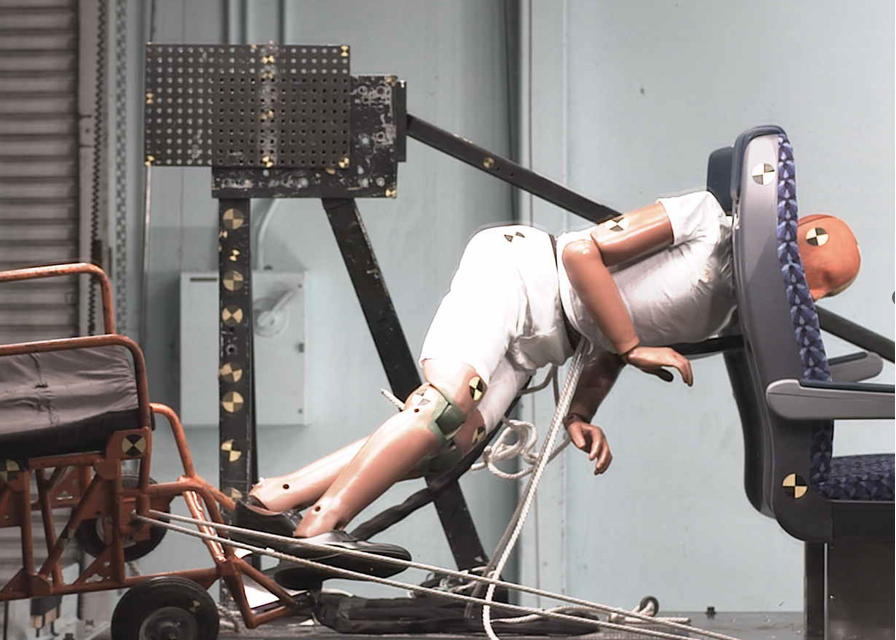
This project explored potential safety benefits of using WTORS on trains by conducting 8-g forward-facing impact tests, to compare kinematic and injury response outcomes. This pulse is specified in 49CFR238.233 for interior fixture attachment strength requirements and in the American Public Transportation Association (APTA) PR-CS-S-016 and S-018 for rail passenger seat and table safety testing (APTA, 2023). Three tests, two with WTORS and one without, were conducted using a surrogate wheelchair (SWC) and an instrumented, mid-size male, Hybrid III (H3-50M) ATD.
The results show that the WTORS were effective at limiting forward excursion of the SWC and ATD. In the test with no WTORS, the ATD moved forward and lodged its head between the forward pair of train seats, while the SWC became a projectile. The ATD injury response measures were 1.3 to 94 times higher when no WTORS was used.
These tests illustrate how WTORS could improve safety for rail passengers riding while seated in their wheelchairs. Any WTORS used in the rail environment needs to accommodate a wide range of wheelchairs, allow independent operation by the wheelchair rider, and be crashworthy in the 8-g impact test.
The portion of the project taking place between July 2026 to February 2027 will involve five tests total: two tests with an unrestrained occupant/unsecured wheelchair condition, one test with an unrestrained occupant in a wheelchair secured by UDIG-compatible hardware, and two tests with occupants restrained by lap/shoulder belts in wheelchairs secured by UDIG-compatible hardware.
Related Publications
Manary MA, Orton NR, Klinich KD (2026) Sled Tests to Evaluate Wheelchair Securement and ATD Restraint Systems in Simulated Train Impact. DOT/FRA/ORD-26/19. Federal Railroad Administration.